




| Morning and Evening |
| Charles H. Spurgeon, 27th October |
|
Morning Verse "It is a faithful saying." 2 Timothy 2:11 Paul has four of these "faithful sayings." The first occurs in 1 Timothy 1:15, "This is a faithful saying, and worthy of all acceptation, that Christ Jesus came into the world to save sinners." The next is in 1 Timothy 4:6, "Godliness is profitable unto all things, having the promise of the life that now is, and of that which is to come. This is a faithful saying, and worthy of all acceptation." The third is in 2 Timothy 2:12, "It is a faithful saying—If we suffer with Him we shall also reign with Him"; and the fourth is in Titus 3:3, "This is a faithful saying, that they which have believed in God might be careful to maintain good works." We may trace a connection between these faithful sayings. The first one lays the foundation of our eternal salvation in the free grace of God, as shown to us in the mission of the great Redeemer. The next affirms the double blessedness which we obtain through this salvation—the blessings of the upper and nether springs—of time and of eternity. The third shows one of the duties to which the chosen people are called; we are ordained to suffer for Christ with the promise that "if we suffer, we shall also reign with Him." The last sets forth the active form of Christian service, bidding us diligently to maintain good works. Thus we have the root of salvation in free grace; next, the privileges of that salvation in the life which now is, and in that which is to come; and we have also the two great branches of suffering with Christ and serving with Christ, loaded with the fruits of the Spirit. Treasure up these faithful sayings. Let them be the guides of our life, our comfort, and our instruction. The apostle of the Gentiles proved them to be faithful, they are faithful still, not one word shall fall to the ground; they are worthy of all acceptation, let us accept them now, and prove their faithfulness. Let these four faithful sayings be written on the four corners of My house. Evening Verse "We are all as an unclean thing." Isaiah 64:6 The believer is a new creature, he belongs to a holy generation and a peculiar people—the Spirit of God is in him, and in all respects, he is far removed from the natural man; but for all that the Christian is a sinner still. He is so from the imperfection of his nature, and will continue so to the end of his earthly life. The black fingers of sin leave smuts upon our fairest robes. Sin mars our repentance, ere the great Potter has finished it, upon the wheel. Selfishness defiles our tears, and unbelief tampers with our faith. The best thing we ever did apart from the merit of Jesus only swelled the number of our sins; for when we have been most pure in our own sight, yet, like the heavens, we are not pure in God's sight; and as He charged His angels with folly, much more must He charge us with it, even in our most angelic frames of mind. The song which thrills to heaven, and seeks to emulate seraphic strains, hath human discords in it. The prayer which moves the arm of God is still a bruised and battered prayer, and only moves that arm because the sinless One, the great Mediator, has stepped in to take away the sin of our supplication. The most golden faith or the purest degree of sanctification to which a Christian ever attained on earth, has still so much alloy in it as to be only worthy of the flames, in itself considered. Every night we look in the glass we see a sinner, and had need confess, "We are all as an unclean thing, and all our righteousnesses are as filthy rags." Oh, how precious the blood of Christ to such hearts as ours! How priceless a gift is His perfect righteousness! And how bright the hope of perfect holiness hereafter! Even now, though sin dwells in us, its power is broken. It has no dominion; it is a broken-backed snake; we are in bitter conflict with it, but it is with a vanquished foe that we have to deal. Yet a little while and we shall enter victoriously into the city where nothing defileth. |
| View book information View author information |
 Calvinist Baptist
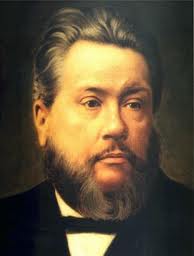
Spurgeon was born in Kelvedon, Essex, to a family of clerics. His father and grandfather were Nonconformist ministers (meaning they weren't Anglicans), and Spurgeon's earliest memories were of looking at the pictures in Pilgrim's Progress and Foxe's Book of Martyrs. His formal education was limited, even by nineteenth-century standards: he attended local schools for a few years but never earned a university degree. He lived in Cambridge for a time, where he combined the roles of scholar and teaching assistant and was briefly tutored in Greek. Though he eschewed formal education, all his life he valued learning and books—especially those by Puritan divines—and his personal library eventually exceeded 12,000 volumes. At age 15, Spurgeon broke with family tradition by becoming a Baptist. He attributed this conversion to a sermon heard by "chance"—when a snowstorm blew him away from his destination into a Primitive Methodist chapel. The experience forced Spurgeon to re-evaluate his idea on, among other things, infant baptism. Within four months he was baptized and joined a Baptist church. His theology, however, remained more or less Calvinist, though he liked to think of himself as a "mere Christian." "I am never ashamed to avow myself a Calvinist," he once said. "I do not hesitate to take the name of Baptist, but if I am asked what is my creed, I reply, 'It is Jesus Christ.'" Preaching sensation Still a teen, Spurgeon began preaching in rural Cambridgeshire. He quickly filled the pews in his first pastorate in the village of Waterbeach. He had a boyish appearance that contrasted sharply with the maturity of his sermons. He had a good memory and always spoke extemporaneously from an outline. His energy and oratorical skills and harmonious voice earned him such a reputation that within a year and a half, he was invited to preach in London, at the historic New Park Street Chapel. The congregation of 232 was so impressed, it voted for him to preach an additional six months. He moved to the city and never left. As word spread of his abilities, he was invited to preach throughout London and the nation. No chapel seemed large enough to hold those who wanted to hear the "the preaching sensation of London." He preached to tens of thousands in London's greatest halls—Exeter, Surry Gardens, Agricultural. In 1861 his congregation, which kept extending his call, moved to the new Metropolitan Tabernacle, which seated 5,600. At the centre of controversy Spurgeon did not go unnoticed in the secular press. On the one hand, his sermons were published in the Monday edition of the London Times, and even the New York Times. On the other hand, he was severely criticized by more traditional Protestants. His dramatic flair—he would pace the platform, acting out biblical stories, and fill his sermons with sentimental tales of dying children, grieving parents, and repentant harlots—offended many, and he was called "the Exeter Hall demagogue" and "the pulpit buffoon." Spurgeon replied, "I am perhaps vulgar, but it is not intentional, save that I must and will make people listen. My firm conviction is that we have had enough polite preachers." Not only his style, but his convictions created controversy as well. He never flinched from strong preaching: in a sermon on Acts 26:28, he said, "Almost persuaded to be a Christian is like the man who was almost pardoned, but he was hanged; like the man who was almost rescued, but he was burned in the house. A man that is almost saved is damned." On certain subjects, he was incapable of moderation: Rome, ritualism, hypocrisy, and modernism—the last of which became the centre of a controversy that would mark his last years in ministry. The "Down-Grade Controversy," as it came to be known, was started in 1887 when Spurgeon began publicly claiming that some of his fellow Baptist ministers were "down grading" the faith. This was the late-nineteenth century, when Darwinism and critical biblical scholarship were compelling many Christians to re-evaluate their understanding of the Bible. Spurgeon believed the issue was not one of interpretation but of the essentials of the faith. He proclaimed in his monthly, The Sword and the Trowel, "Our warfare is with men who are giving up the atoning sacrifice, denying the inspiration of Holy Scripture, and casting slurs upon justification by faith." The controversy took its toll on the denomination (which censured Spurgeon) and upon Spurgeon, whose already delicate health deteriorated even more during the year-long affair (he suffered from, among other things, recurring depressions and gout). Spurgeon's contributions were larger than his pulpit, however. He established alms houses and an orphanage, and his Pastor's College, opened in 1855, continues to this day. He preached his last sermon in June 1891 and died six months later. When Charles Spurgeon died in January 1892, London went into mourning. Nearly 60,000 people came to pay homage during the three days his body lay in state at the Metropolitan Tabernacle. Some 100,000 lined the streets as a funeral parade two miles long followed his hearse from the Tabernacle to the cemetery. Flags flew at half-staff and shops and pubs were closed. |
| View book information View devotional |
| For more than 150 years, Morning and Evening has provided millions of readers encouragement, challenge, and thought-provoking insight from the pen of one of history's most beloved preachers, Charles H. Spurgeon. Spurgeon's sermons and other writing have touched countless lives, and his insight into perseverance through times of trial while relying on God's immeasurable strength still speaks to readers today. This fantastic gift edition of Spurgeon's bestselling daily devotional contains the complete, original twice-daily text |
| View author information View devotional |

|

|